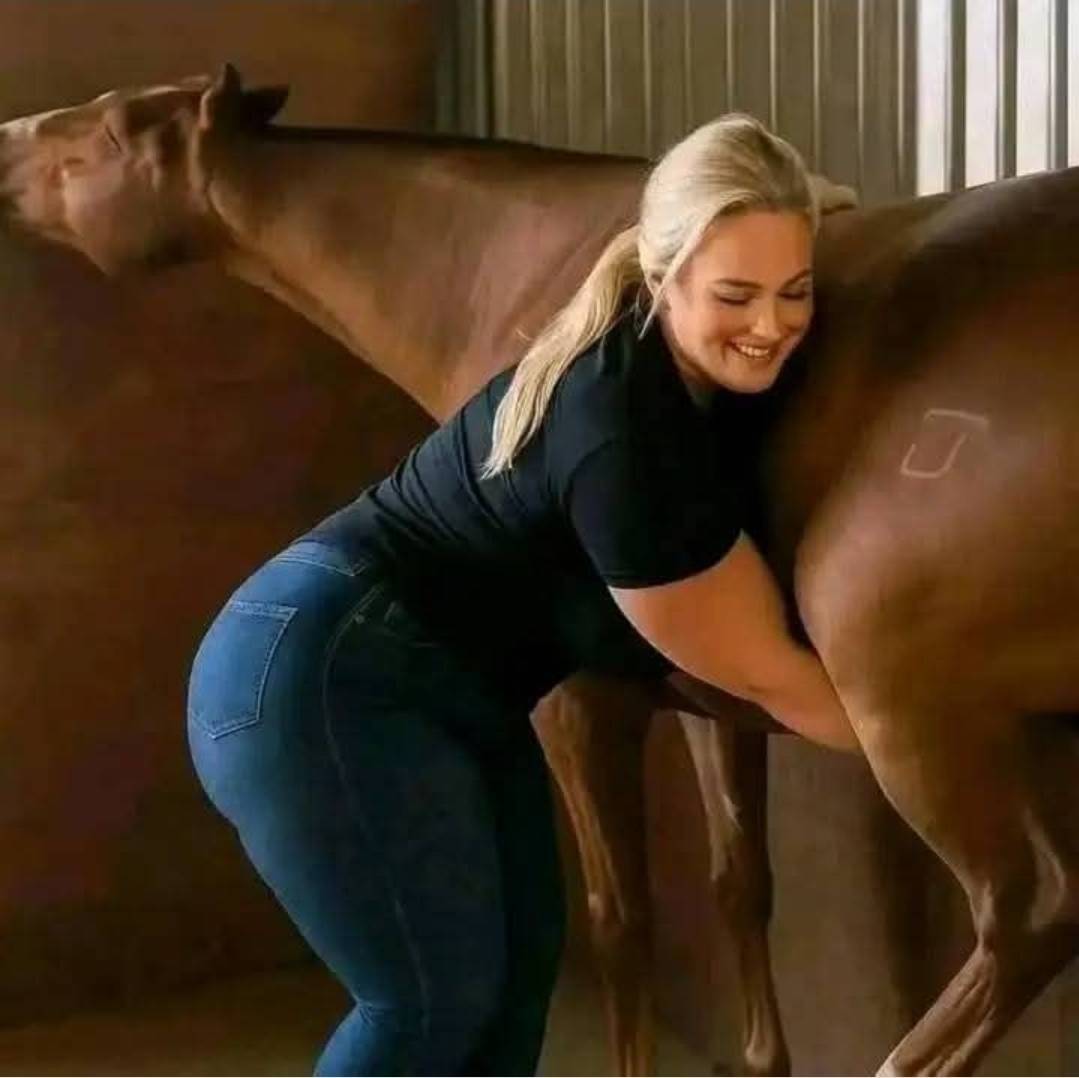
“I haven’t had sex in six months,” the Giant Apache Woman told the Rancher.
1. Dust and Arrival
The dust from Parras, Coahuila, rose like a lost soul over the parched fields of La Esperanza ranch. It was August, and the sun burned even the shadows. The men of the ranch hadn’t spoken to each other for three days. The boss, Don Crispín Saldívar, had died in a cantina during a confusing brawl that no one understood. No one knew who had started it or why, but the silence that followed was thicker than molasses.
In the middle of the corral, seated on an old log, was the quietest cowboy in the north: Anselmo, nicknamed Mute Wheels. He was 34 years old, a widower since 27, with a weathered face and a Colt revolver that seemed like an extension of his left hand. He had spent months living in absolute peace, bothering no one and not visiting nearby towns, dedicated solely to the work of the ranch and the silence that surrounded him.
That afternoon, when the heat seemed to bend the horizon, she arrived. The cart brought from Torreón creaked as it stopped in front of the hacienda. From the canvas emerged a woman who made all the farmhands cross themselves twice. She was two meters and seven centimeters tall, barefoot, with strong arms and solid legs, the imposing presence of someone accustomed to long journeys. Her coppery-red hair was gathered in a thick braid that reached her waist. She wore a short, worn dress of coarse cotton, as if it had survived more than one difficult trip.
Her name was Brígida Ofarril, Irish on her father’s side, Tarahumara on her mother’s. She was 29 years old, an orphan from the circus. She had been moved several times between different traveling troupes, and on each occasion, she managed to leave of her own accord. The Malacara brothers, who had recently been presenting her as the giantess of the desert, claimed it was all part of their act, but one had turned up badly injured along the way, and the other insisted it was all her fault, though no one truly believed him.
Now she was there, sitting against the wall of the corral, with her knees almost to her chest and an ugly wound on her left leg.
2. The encounter and the confession
Anselmo saw her and felt a strange mixture of concern and respect. He approached slowly, like someone afraid of waking a sacred animal.
“Who hurt you, woman?” he asked in that hoarse voice he rarely used.
Brígida looked down at him, even though she was sitting down. Her eyes were green like old mezcal.
“A heartless man who tried to take advantage of my path,” he replied bluntly, “but he couldn’t get the better of me.”
Then he added something that surprised everyone with its sincerity:
—I haven’t been able to rest in peace for months. I just want tranquility and a place where no one will bother me.
Anselmo swallowed so hard it could be heard all the way to the corral. From that moment on, something changed in the air.
The farmhands murmured that the giantess was a witch, that she had survived dangers that would have brought down any man, that if you looked at her for too long she would frighten your very soul. Anselmo didn’t believe in witches, but he did believe in the strength she exuded when she passed by.
That night he took her to the tool shed, the only place big enough for her. He treated her wound with brandy and clean rags. She didn’t complain once.
When she finished bandaging him, Brigida took the cowboy’s face in her enormous, though soft, hand.
—You’ve experienced a lot, haven’t you?
He barely nodded.
“Well, now we’re in a place where maybe we can start from scratch,” she said with a laugh that made the beams tremble.
3. The telegram and the decision
On the second day, a telegram arrived. Colonel Epifanio Garza, the deceased Don Crispín’s close friend, was coming with thirty men to seize the ranch. He claimed the will was forged and that the land belonged to him due to old debts.
The laborers began to desert. Anselmo stayed, and so did Brígida.
“Why don’t you leave?” he asked her.
“Because you’re not leaving,” she replied. “And because I don’t intend to let another act of abuse go unanswered.”
That night, as the ranch emptied out, Anselmo and Brígida shared bread and coffee in the kitchen. The silence between them was comfortable. She told him about her experiences in circuses, fairs, and underground fights. She said the last time she’d had sex was six months earlier, with a man who hadn’t respected her and who had run away when she fought back.
“I haven’t had sex in six months,” she said, without shame. “And I don’t miss it. What I miss is peace.”
Anselmo simply stared at her. It wasn’t a vulgar confession, but the declaration of a woman tired of being treated like a spectacle.
4. The corpse and the bath
On the third day, the foreman’s body was found in the large mesquite tree, the victim of an attack no one could explain. Fear grew thick as molasses.
That same afternoon, Anselmo found Brígida bathing in the Hawai, the ranch’s natural pond. The water barely reached her waist. She was breathing deeply, seeking peace. He was paralyzed.
She didn’t get upset.
“Are you going to just stand there watching, or are you coming to help me check the wound?” he said calmly.
Anselmo stepped into the water fully clothed. He washed her leg carefully. His hands trembled, not from undue nervousness, but from the responsibility of not hurting her. She was strong, but also human, and in that moment he understood that deeply.
Then a shot rang out, a sniper on the hill. The bullet grazed Anselmo’s head and took off half his hat. They ran toward the hacienda.
Colonel Garza had arrived ahead of schedule.
5. The battle
Day four, the battle. Thirty men against two. It seemed impossible, but Brígida loaded a Winchester 1873 that seemed light in her hands. Anselmo took his Colt and an old rifle. They fought from the windows.
Brígida moved with precision, Anselmo with discipline. They managed to push back the opposing group without causing unnecessary destruction.
When only ten enemies remained, Colonel Garza shouted that they were surrendering, but they tried to force their way in. Anselmo fell wounded in the shoulder.
Brígida carried him like a child and took him to the basement. There, among sacks of corn and the smell of gunpowder, she took off his shirt to tend to him. She carefully cleaned the blood from his body.
“You’re going to be okay,” he told her. “I won’t let anything happen to you.”
Her words comforted him more than any medicine.
6. The truth and the letter
Fifth day, the revelation. Colonel Garza managed to reach the basement with five men. He found them exhausted, covered in sweat and dust.
Garza laughed.
—So the giantess and the mute man, a curious couple.
But Brígida, still exhausted, grabbed an iron bar and defended herself. Anselmo, wounded and alive, also got up to help. In a few minutes they managed to neutralize the threat without allowing any more bloodshed than necessary.
Then Garza, before being subdued, dropped the bombshell.
—The true heir to the ranch wasn’t Crispín, it was you, Anselmo. You’re his son. He left you everything, that’s why they wanted you out.
Anselmo froze. Brígida hugged him from behind, her arms tightly wrapped around him.
“Well, now the ranch is yours,” she said calmly. “And you’ll be safe here.”
On the sixth day, a letter arrived with a Monterrey stamp. It was signed: Sister María de los Ángeles Ofarril, Brígida’s older sister, a cloistered nun. It stated that Brígida was not simply a traveler, but a woman who had suffered a forced marriage and escaped to protect herself. Since then, they had been searching for her without understanding her story.
Anselmo read the letter and said nothing. Brígida looked at him with those stormy green eyes.
—Are you going to hand me over?
He burned the letter in the fireplace.
—No letter has arrived here.
She took a deep breath and hugged him. They both remained silent, understanding that they trusted each other.
7. The final duel
Seventh day, the final showdown. The Malacara brothers were not dead. The younger one had survived and brought a hundred men from the frontier. They surrounded the ranch. This time there was no escape.
Anselmo and Brígida went out to the corral at dawn. She carried two sawed-off shotguns, he carried the Colt and the rifle. They stood back to back, just like in the legends.
“When this is over,” she said, “I want you to remember that we did the right thing.”
The battle was long. They fired until they ran out of bullets. Then they defended themselves as best they could, not seeking to cause unnecessary damage, only protecting themselves. Many attackers fell.
In the end, only the smaller Malacara remained, filled with rage.
“You ruined my life,” he shouted at Brígida.
—And you hurt my family —she replied.
With a firm movement, he managed to stop him without taking his life, handing him over to the authorities when they arrived.
8. The Goodbye
When it was all over, Anselmo was on his knees, exhausted from his wounds. Brígida supported him again. She carried him to the hut where they had spent their first night. There, with the sun rising red over Parras, she said to him:
“I appreciate you more than I ever imagined, cowboy, but I can’t stay. They’re looking for me in several places, and if they find me here, they’ll put you in danger.”
He tried to speak, but he had no voice left. She hugged him one last time. A long embrace, full of unspoken feelings. Then she walked away into the desert, barefoot, her dress torn and her braid undone, so long it seemed the horizon itself bent to let her pass.
Anselmo was left alone on the ranch. He never spoke again. But every night, when the wind carried a distant echo, a woman’s laughter made the mesquite trees tremble.
9. The legend
In the cantinas of Coahuila they still say that if you pass through La Esperanza on a full moon, you can see a red giantess sitting in the corral, waiting for the day when the roads cross paths again with that cowboy who gave her peace and freedom.
They say that the story of Brígida and Anselmo is the story of two wandering souls, united by pain and strength, separated by destiny, but eternally connected by the earth and the wind.
When the villagers see the silhouette of the giantess on the horizon, they remember that some loves need no words, no promises, no bodies. Loves that live on in memory and in the hope of meeting again.
And so, beneath the vast Coahuila sky, the La Esperanza ranch still stands. Dust continues to rise like a lost soul, but now, in every corner, there are traces of a woman who defied all limits and of a man who learned that true peace lies not in silence, but in the memory of one who knew how to love without fear.