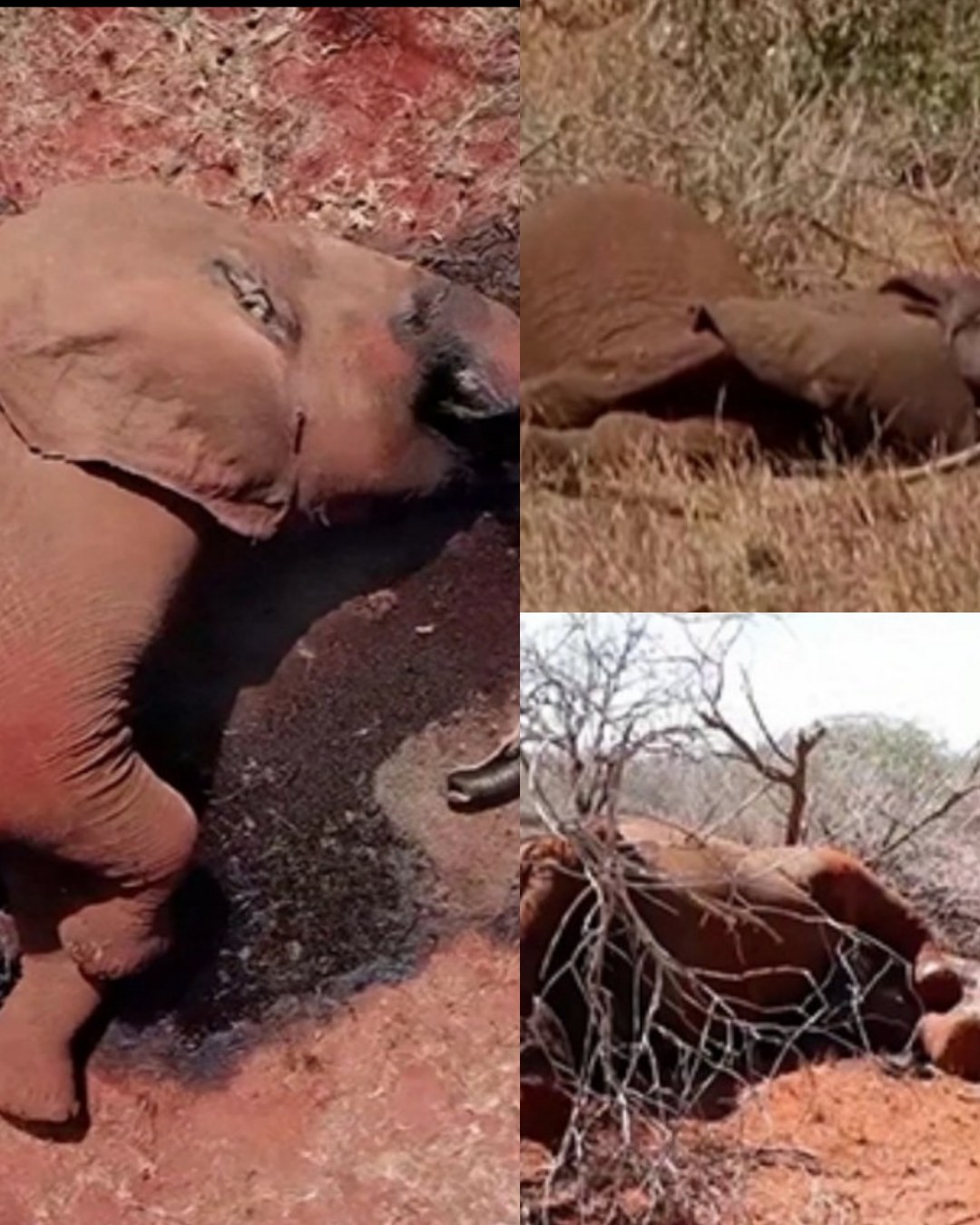
The sun hung low over the cracked African plains, rolling out heat in suffocating waves. Dust swirled with every whisper of wind, coating the earth in a rusty cloak that shimmered beneath the burning sky. What had once been a vibrant stretch of life—where elephants roamed with thunder in their footsteps and trees sheltered entire ecosystems—was now silent, as if the world itself were holding its breath.
Among this silence walked Amani, a young wildlife ranger whose name meant “peace.” But on this land, peace had become a luxury few could afford. Her boots pressed into the dry soil, creating small clouds of powder that drifted behind her. She had walked these plains since she was a child, learning every tree, every trail, every sound that traveled across the open space. But nothing prepared her for the landscape she now patrolled.
Before her lay an elephant, collapsed under a tangle of dry branches—its once-mighty frame stilled by a drought that showed no mercy. Amani knelt beside it, her hand trembling as she touched the thick, dusty hide. The earth around the fallen giant was disturbed, marked by desperate attempts to rise. She felt the weight of its suffering in her chest, tightening like a grip she could not loosen.
This was not the first she had found. It would not be the last.
Weeks of scorching heat had turned rivers into cracked scars in the ground. The life-giving waterholes that once reflected the sky now reflected nothing at all. The herd—nearly two hundred strong—had wandered farther and farther in search of water, only to collapse along the way. Mothers fell beside their calves, their trunks entwined even at the end, leaving heartbreaking scenes that tore at Amani’s spirit.
Still, she walked on. Because someone had to.
Because hope, even fragile, needed footsteps to follow.

But on this day, as Amani inspected the area, something shifted within the stillness. A faint tremor. A sound too soft to be wind yet too alive to ignore. She turned her head slowly, listening. There it was again—a weak, breathy rumble.
A baby elephant.
Amani’s heart raced as she followed the sound around the dry brush. There, half hidden behind a cluster of brittle shrubs, lay a small calf. Its body was thin, its eyes dim, but it was breathing—faintly, stubbornly, as if clinging to the last thread of existence.
“Hey there, little one,” Amani whispered, lowering herself to its level. “You’re still fighting.”
And that single breath of determination—small as it was—sparked something powerful inside her.
This story did not have to end in silence.
This could become a touching story, a heartwarming story, an inspiring story of one life saved in the middle of tragedy.
Amani radioed her team, her voice steadier than she felt. Minutes felt like hours as she stayed beside the calf, shielding it from the sun with her own body. When her colleagues arrived, they worked with delicate hands, lifting the young elephant onto a makeshift stretcher crafted from heavy canvas and wooden poles.
“We’ll get you to water,” Amani promised softly. “I’m right here.”
The journey was slow. Their vehicle had broken down days earlier from overuse and overheating, forcing them to rely on manpower alone. Sweat traced paths down their dust-covered faces, and their muscles burned with each step. But the calf’s faint breaths pushed them forward.
At the rescue outpost, the team immediately set up shade and warm electrolyte solutions. The calf trembled, too weak to stand, but its eyes flickered open with each sip offered. Amani stayed beside it for hours, whispering encouragement as if her voice alone could anchor the life slipping in and out of the calf’s grasp.
Days passed.
The drought did not ease, but the calf’s strength began to return. First, it lifted its head. Then it pushed itself up on unsteady legs. The team erupted in cheers the moment it managed to stand fully—wobbly but triumphant.
They named the calf Tumaini, meaning hope.
And hope, indeed, radiated from every step the tiny elephant took as it explored the enclosure, nudging Amani with gentle curiosity, trusting her completely. The bond between them became a heartwarming story repeated across the camp, lifting spirits in a time of despair.

Yet Amani knew this rescue was only the beginning.
The loss of nearly two hundred elephants had left a scar not only on the land but on the hearts of everyone who had witnessed it. She felt the weight of their memories every time she watched Tumaini drink from the water trough, every time she heard his soft trumpet echo across the barren field.
But she also felt determination—stronger than grief, brighter than exhaustion.
She worked day and night, reaching out to conservation groups, coordinating water delivery trucks, creating emergency troughs across the plains. Volunteers arrived from distant villages, touched by the inspiring story of a calf that survived when so many giants had fallen. Together they dug wells, carried barrels of water, erected shade structures, and revived dried-up ponds.
Slowly—miraculously—the plains began to breathe again.
Animals returned to the troughs. Birds circled the sky. Even the wind felt different, carrying with it a sense of renewal.
Tumaini grew stronger with each sunrise. His ears flapped eagerly, his steps gained confidence, and he followed Amani everywhere like a shadow made of joy.
Where there had been silence, there was now life.
Where there had been grief, there was now purpose.
Where drought had left devastation, compassion began to rebuild.

Months later, when the first rains finally arrived, the entire team stood outside, letting the cool drops wash away the dust of endless weeks. Tumaini lifted his trunk to the sky, trumpeting triumphantly as water splashed across his back. The sound echoed through the plains like a promise—one that carried the memory of the herd, the courage of those who tried to save them, and the hope of all who believed that kindness could rewrite even the harshest fate.
Amani closed her eyes, letting the rain mingle with her tears—tears not of sorrow, but of gratitude. This land had suffered deeply, but it was healing. And Tumaini, the little survivor who refused to give up, was proof that even one life saved can ignite a ripple of compassion across the world.
This was more than a rescue.
This was a touching story that reminded people everywhere that every act of empathy matters.
This was a heartwarming story that showed how unity can overcome even the harshest drought.
This was an inspiring story that proved hope can rise from dust.
And as Amani watched Tumaini play in the rain, she knew one truth more strongly than ever:
The great herd had not fallen in vain.
For from their silence, a new beginning had been born—one that the world was only just beginning to understand.