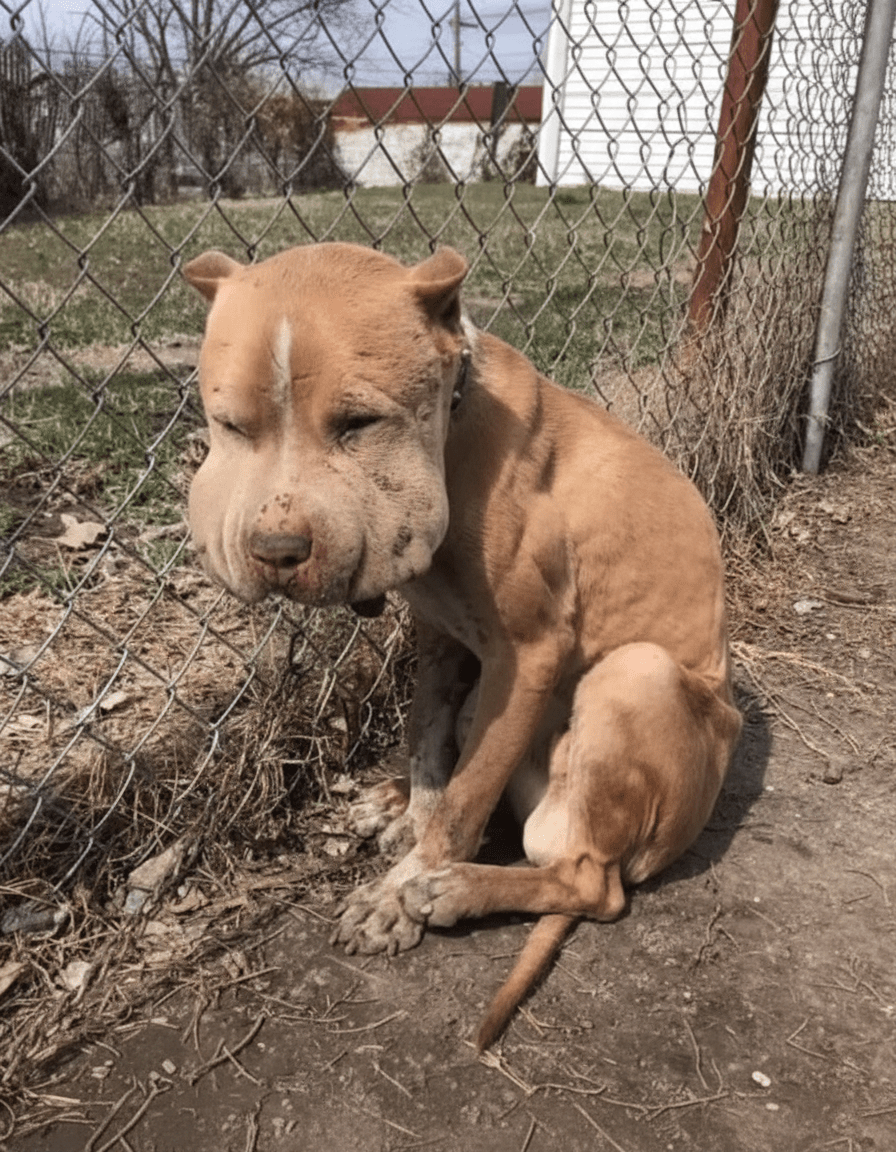
In the chilly dawn of March 15, 2024, on the outskirts of a rundown industrial suburb in Detroit, Michigan, a heart-wrenching sight greeted early-morning jogger Maria Gonzalez as she navigated her usual route along the cracked sidewalks of Jefferson Avenue. There, chained to a rusted chain-link fence surrounding an abandoned auto parts warehouse, sat a large, fawn-colored pitbull with an extraordinarily swollen face that made her resemble a caricature of despair. Her cheeks puffed out like overinflated balloons, her eyes half-shut in exhaustion, and her body trembled uncontrollably—not from the crisp 38°F air, but from sheer terror and malnutrition. The dog’s collar, embedded deep into her neck from prolonged neglect, was caked with dirt and what appeared to be dried blood. Gonzalez, a 42-year-old nurse who had recently immigrated from Mexico, froze in her tracks, her fitness tracker beeping wildly as her heart rate spiked. What she didn’t know was that this trembling creature, later named “Puffy” by rescuers, was about to unravel a bizarre chain of events involving an international smuggling ring, a forgotten circus act, and a twist of fate that would captivate animal lovers worldwide.

Maria’s initial instinct was to call 911, but as she approached cautiously, phone in hand, Puffy let out a low, guttural whine that pierced the quiet morning. The dog’s head was disproportionately large, her muzzle distorted by massive, infected abscesses that oozed a yellowish pus, matting her short fur. Her ribs protruded sharply beneath her taut skin, and her hind legs were splayed awkwardly, suggesting possible nerve damage from being tied in that position for days—or even weeks. “I thought she was dying right there,” Gonzalez later recounted in an interview with local news station WDIV. Snapping photos to document the scene, she noticed something peculiar: a small, tarnished metal tag dangling from the collar, engraved not with a name or phone number, but with faded Cyrillic script reading “Круг 2019” – which translated roughly to “Circle 2019.” Unfamiliar with Russian, Gonzalez dismissed it as graffiti and focused on freeing the dog. Using a pair of work gloves from her fanny pack, she carefully unclasped the chain, which had rusted shut, and coaxed Puffy into her car with a half-eaten protein bar.
What followed was a cascade of unexpected discoveries that transformed this routine rescue into a global story. Gonzalez rushed Puffy to the nearest emergency vet clinic, Animal Care Clinic on Gratiot Avenue, where Dr. Elena Vasquez, a specialist in exotic animal injuries, took one look at the dog’s face and suspected something far beyond typical abuse. “I’ve seen hundreds of pitbulls with facial trauma from fights, but this was different,” Vasquez explained. “Her cheeks were filled with fluid pockets larger than tennis balls, and there was a metallic tang to the infection—not consistent with standard bacterial growth.” X-rays revealed the shocking truth: embedded deep within each swollen cheek were fragments of what appeared to be microchips and tiny, corroded steel ball bearings. Further analysis using a portable spectrometer showed traces of rare earth metals, hinting at industrial sabotage rather than animal cruelty.
As veterinarians worked around the clock to drain the abscesses— a grueling 12-hour surgery that removed over a liter of infected fluid—investigators from the Michigan Humane Society arrived, alerted by Gonzalez’s viral social media post that had already garnered 50,000 views. The Cyrillic tag led them to a surprising lead: a defunct Russian circus troupe called “Moscow Moonlight Circus” that had toured the U.S. Midwest in 2019. Records showed they had performed in nearby Toledo, Ohio, featuring “extreme performance dogs” trained for agility shows. But here’s where the story took its first jaw-dropping turn: Puffy wasn’t just any dog. Microchip scans, once the facial swelling subsided enough to access her original ID, revealed she had been imported legally from Ukraine in 2018 as part of a breeding program for “pocket bullies”—a compact variant of American Bullies prized for their exaggerated, muscular features.

However, the ball bearings told a darker tale. Forensic experts from the University of Michigan’s veterinary pathology lab determined they were not accidental; they matched components from counterfeit GPS trackers used in an international pet smuggling operation. According to a subsequent FBI report, Puffy had been stolen from a breeder in Poland during a 2022 raid linked to Eastern European crime syndicates trafficking high-value dogs into the U.S. black market. The “puffy cheeks” weren’t from natural deformity or even botched surgery—they were the result of forced implantation. Smugglers had injected the bearings and chips under her skin to track valuable breeding stock across borders, but a botched procedure caused chronic infection, ballooning her face to grotesque proportions. “She was a living GPS device gone wrong,” said FBI Agent Carla Ruiz during a press conference. “These rings embed tech in dogs to monitor shipments hidden in cargo containers from ports like Baltimore to Detroit.”
The rescue’s plot thickened with yet another unforeseen detail: Puffy’s owner was no anonymous abuser. Warehouse surveillance footage, recovered after police raided the site, showed a gaunt man in his 60s dumping the dog there at 2 a.m. on March 14. Facial recognition software identified him as Viktor Kuznetsov, a former Moscow circus veterinarian who had defected to the U.S. in 2020 and was living under an assumed identity in Warren, Michigan. Kuznetsov confessed during interrogation that he had bought Puffy on the black market two years earlier, intending to use her for underground fighting rings popular in Detroit’s underbelly. But when her face became too disfigured—rendering her “unusable” for bets—he abandoned her, chaining her to the fence with a prayer that someone would end her suffering. “I couldn’t afford the vet bills, and she was in agony,” he claimed, though authorities dismissed this as a ploy for leniency.
Puffy’s recovery became a beacon of hope amid the grim revelations. After surgery, she was placed in a foster home with Gonzalez, who had volunteered full-time from her nursing shifts. Antibiotics and specialized hydrotherapy reduced her facial swelling by 80% within weeks, revealing a strikingly beautiful, symmetrical face with soulful hazel eyes. Weighing just 42 pounds upon rescue (down from an estimated healthy 70), she gained strength rapidly on a diet of high-protein kibble laced with fish oil. Unexpectedly, Puffy revealed hidden talents: during play sessions, she performed flawless “circus tricks” like spinning in circles and balancing on hind legs—skills ingrained from her early training. Videos of these feats exploded online, amassing over 10 million views on TikTok and Instagram, drawing donations exceeding $150,000 to Michigan Humane’s pitbull rehabilitation fund.
The story’s global ripple effect was profound. In the UK, the RSPCA launched “Operation Tracker,” screening 500 rescued dogs for embedded tech, uncovering three similar cases in London. Australia reported a spike in bully breed imports with anomalous X-rays, prompting border quarantine reforms. Even in remote Argentina, a Buenos Aires shelter found a dog with identical cheek implants, linking back to the same Polish smuggling network. Puffy’s saga prompted U.S. Congresswoman Rashida Tlaib to introduce the “Canine Protection Act of 2024,” mandating advanced scanning for all imported pets.
Today, as of November 2025, Puffy—now officially adopted by Maria Gonzalez—thrives in a cozy Detroit suburb. Her once-puffy face is sleek and scar-minimal, and she serves as a therapy dog at local schools, comforting children with her gentle demeanor. “She went from trembling in fear to teaching us all about resilience,” Gonzalez said, petting Puffy’s soft ears. What began as a jogger’s chance encounter has exposed a hidden underworld of animal exploitation, forged unbreakable human-canine bonds, and reminded the world that even in the depths of despair, miracles hide in the unlikeliest places. Puffy’s story isn’t just about survival; it’s a testament to the unexpected ways compassion can dismantle criminal empires, one rescue at a time.
