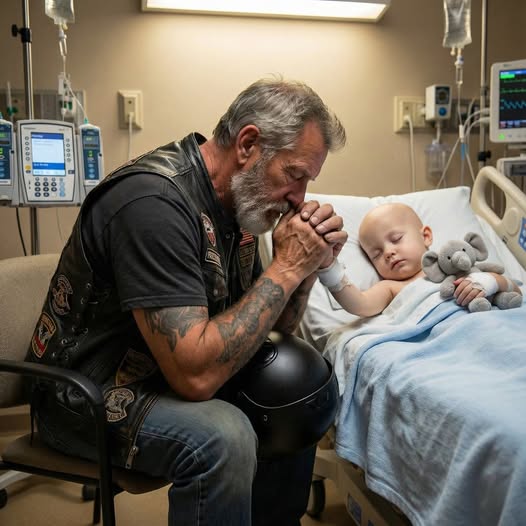
The boy asked me to hold his hand while he died because his own father wouldn’t. I’m a sixty-three-year-old biker, tattooed from shoulder to wrist, with a beard hanging to my chest. I’ve buried brothers from the service. I’ve witnessed things that would break most men. But nothing prepared me for a seven-year-old cancer patient looking up at me and saying those words.
“Mister, will you stay with me? My daddy says hospitals make him sad, so he doesn’t come anymore.”
I first met Ethan three months earlier during a charity toy run. Our motorcycle club delivers toys to the children’s hospital every Christmas. I’ve been part of it for twenty-two years. Usually, you hand out some stuffed animals, smile for a few photos, and walk out feeling like you’ve done something good.
But Ethan wasn’t like the other kids.
He sat alone in his room while every child around him had family packed inside. No balloons. No cards. No parents holding him close. Just a bald, frail little boy in a hospital gown gripping a worn stuffed elephant.
I stopped at his door and asked, “Hey buddy, want a teddy bear?”
He looked up at me with wide blue eyes. He didn’t smile or reach for the toy. He simply stared like he was trying to figure out if I was someone he could trust.
“Are you scared of me?” I asked. Most kids are at first. I’m not exactly gentle-looking.
He slowly shook his head. “No. You look like the bikers on TV. The ones who protect people.”
Something cracked deep inside me when he said that.
“Where are your mom and dad?” I asked.
He stared down at his elephant. “Mommy died when I was four. Cancer too. Daddy says he can’t watch someone he loves die again. So he stays home.”
I froze. A dying child—abandoned by the only parent he had left.
“What’s your name?”
“Ethan. What’s yours?”
“Thomas. But my friends call me Bear.”
For the first time, he nearly smiled. “Because you’re big like a bear?”
“That’s right, buddy.”
He studied me for a long moment, then quietly asked, “Bear, will you be my friend? The nurses are nice, but they’re always busy. And I get really scared at night.”
I should have handed him the toy and moved along. I had my own life, my own problems. I didn’t need to get attached to a child who was dying.
But looking at that lonely boy in that hospital bed, I saw my younger self—different details, same emptiness.
My old man drank too much. My mother worked constantly. I grew up alone, angry, and closed off. Until I found family in my motorcycle club.
Ethan didn’t have that. He had an elephant and a father too shattered to walk through the door.
“Yeah, buddy,” I heard myself say. “I’ll be your friend.”
I came back the next day. And the day after that. And the day after that.
The nurses were wary at first—a huge biker showing up daily to see a dying child. They ran background checks. Called references. Verified every piece of my charity work.
But Ethan didn’t care about any of that. All he cared about was that I came back.
“Bear, you came back!” he said on the third day, his whole face lighting up.
“Told you I would, buddy.”
I brought him a toy motorcycle, showed him photos of my bike, told him stories of riding through mountain roads. He hung onto every word like I was describing a fairytale.
“When I get better, will you take me for a ride?” he asked.
I’d seen his chart. Stage four neuroblastoma. Less than fifteen percent survival rate. The doctors had already told his father nothing more could be done.
“Absolutely,” I said. “When you get better, we’ll go for the longest ride of your life.”
A lie, yes—but a gentle one. One we both silently understood.
In week two, I met Ethan’s father. He arrived one afternoon while I was reading about a brave knight who fought dragons.
He looked like a ghost—thin, pale, exhausted. He stared at me as if I’d trespassed in his home.
“Who are you?” he demanded.
“My name’s Thomas. I’m a friend of Ethan’s.”
“Daddy!” Ethan tried to sit up. “This is Bear! He’s a biker! He comes to see me every day!”
His father’s face tightened. “Every day? You come every day?”
“Yes, sir.”
“Why?”
I looked from the man to his son. “Because someone needed to.”
For a moment I thought he might hit me. Instead he turned and walked out. Ethan’s face fell, the light in his eyes dimming instantly.
“He always leaves,” he whispered. “He can’t look at me anymore.”
I pulled my chair closer. “Your daddy loves you. He’s just broken. Losing your mommy shattered him. And the thought of losing you—”
“Is breaking him more,” Ethan finished softly. “The doctors told me some people can’t handle watching someone they love be sick.”
Seven years old, and he understood grief better than most adults.
“It’s not fair,” I said.
Ethan reached out and took my hand—small, fragile, trusting. “I’m not alone anymore, Bear. I have you.”
I went home that night and cried for the first time in thirty years.
Week three, I brought my club brothers to meet him.
“Ethan, you ready to meet some people?” I said as six of my guys walked in behind me—huge, rough-looking men in leather vests.
Ethan’s eyes widened. “Are they all bikers?”
“Every single one,” I said. “And they wanted to meet the bravest kid I know.”
Marcus brought a toy Harley. Robert brought a leather bracelet with Ethan’s name. Tommy brought a child-sized helmet labeled “Little Warrior.”
“You want to ride someday?” Robert asked. “Then you need your gear.”
Ethan cried. Real tears. Happy tears. “These are for me? Really?”
“Really, little brother,” Marcus said. “You’re one of us now.”
We gave him a tiny vest with patches. “Little Warrior” across the back. “Iron Guardians MC” on the front.
He put it on over his hospital gown and laughed—a real, joyful laugh.
The next day, his father came again. He was worse than before—unshaven, exhausted, defeated.
“Can I talk to you?” he asked. “Outside?”
In the hallway, he broke down completely, collapsing against the wall.
“I can’t do it,” he sobbed. “I watched his mother die in this same hospital. Same floor. Same hell. I can’t go through it again.”
I sat beside him in silence for a long time.
Finally I said, “Your son is dying—whether you’re here or not. The only difference is whether he dies alone or knowing his father loved him enough to stay.”
“I do love him.”
“Then show up. Love is just showing up when it’s hard.”
He stared at me. “How do you do it? You’re not even his father.”
“Because he asked me to,” I said. “I couldn’t walk away.”
He wiped his face. “I should be the one—”
“Then be the one. He’s still here. He’s still waiting.”
He didn’t answer. Just walked away.
Week four, Ethan declined rapidly. More pain meds. More sleep. Less time awake.
I still came every day. Sat by his bed. Held his hand.
“Bear?” he whispered one afternoon.
“I’m here.”
“I’m scared.”
“I know, buddy.”
“When it happens… will you hold my hand? Will you be here?”
I couldn’t speak. Just nodded.
“I wish you were my dad,” he said. “You don’t leave.”
“I’m right here, Ethan. I’m not going anywhere.”
“Promise me something else?” he murmured.
“Anything.”
“Promise you’ll tell my daddy it’s okay. That I understand. That I love him.”
This child—this dying seven-year-old—was trying to comfort the father who had abandoned him.
“I promise,” I whispered.
Four nights later, at midnight, Ethan’s father walked into the room—shaven, steady, changed.
“I’m here,” he said quietly. “I’m not leaving again.”
He sat beside his son and took his hand.
Ethan opened his eyes, saw his father, and smiled.
“Daddy, you came.”
“I’m sorry, son. I was scared. I should have been here.”
“It’s okay, Daddy,” Ethan whispered. “Bear kept me company.”
His father looked at me and mouthed, “Thank you.”
The three of us stayed there all night—Ethan between us, both of us holding his hands.
Four days later, Ethan passed away. His father sat on one side. I sat on the other. He wore his tiny vest with the “Little Warrior” patch.
At the funeral, nearly two hundred bikers came. They lined the roads, engines revving in salute, escorting the smallest coffin I’d ever seen.
Afterward, his father and I stood together at the grave.
“He loved you,” the man said. “You were his hero.”
“He was mine.”
“I don’t know how to thank you.”
“You don’t,” I said, staring at the fresh earth. “You honor him. You show up for others the way he needed someone to show up for him.”
He nodded. “I’m going to volunteer in the pediatric ward. So no kid has to be alone like he was.”
“That’s how you thank him. That’s how you thank me.”
That was two years ago.
I still visit the children’s hospital every week. Still bring toys. Still sit with kids who have no one.
And on my vest, over my heart, I wear a patch with a little boy riding a motorcycle toward the sky. Under it are the words: “Ethan – My Little Warrior – Riding Free Forever.”
Every child I meet, I tell them about Ethan—the bravest boy I ever knew.
And every night, before bed, I hold the stuffed elephant Ethan’s father gave me—the same one Ethan clung to every day.
“Goodnight, little brother,” I whisper. “Save me a spot. When my time comes, we’re going on that ride I promised.”