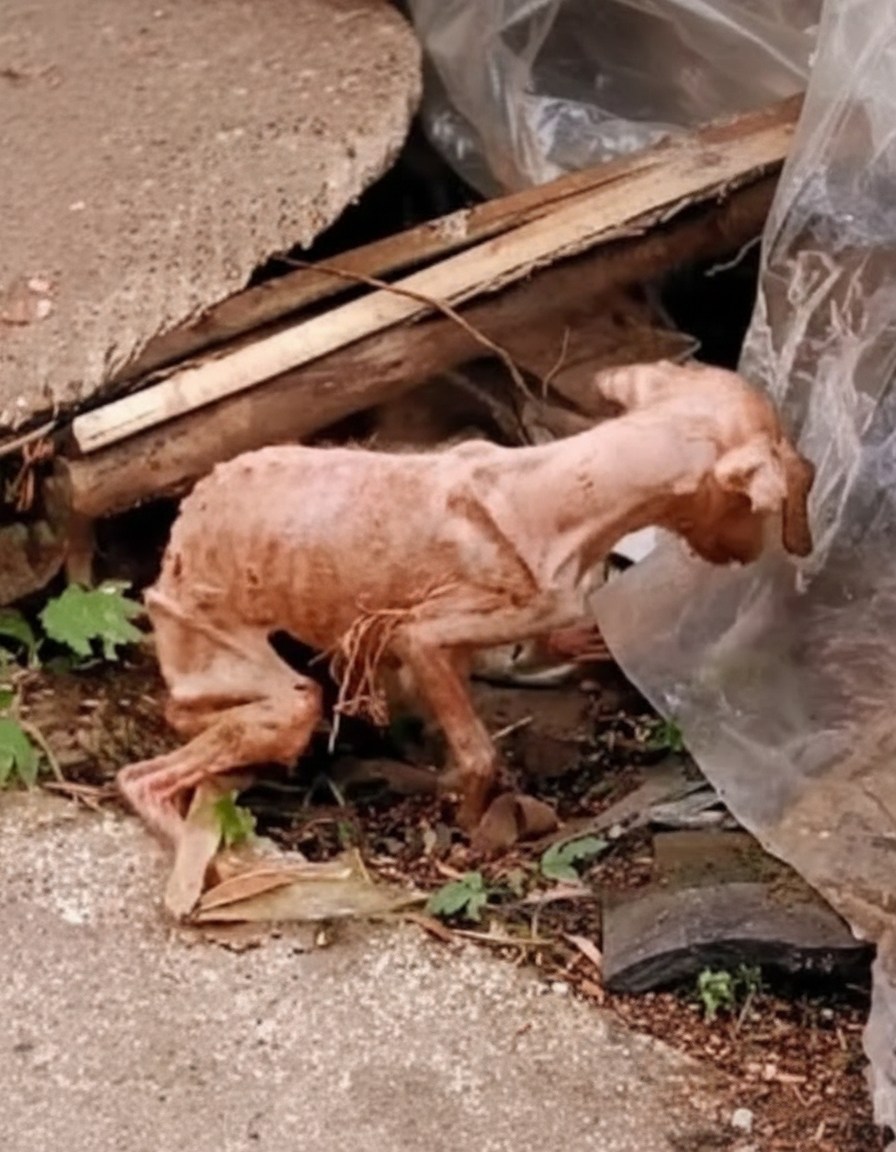
In the sweltering heat of a forgotten corner of rural Thailand, where the Mekong River’s muddy banks meet sprawling rice paddies under a relentless sun, a skeletal figure huddled beneath a makeshift shelter of splintered bamboo and tattered plastic sheeting. It was late August 2025, and the monsoon season had just broken, leaving behind a landscape of knee-deep mud and buzzing clouds of mosquitoes. This was no ordinary scene of rural poverty; it was the final stand of a dog so emaciated that his ribs protruded like the bars of a prison cell, his skin stretched taut over protruding hip bones, and his once-bright coat reduced to patchy remnants clinging to his frame. Abandoned amidst debris—discarded tires, rusted tin cans, and wilted banana leaves—he lay motionless, his shallow breaths barely stirring the humid air. Locals in the village of Ban Huai Sai, a cluster of stilted wooden homes in Thailand’s Isaan region, had noticed him weeks earlier, dubbing him “Kwai Nok,” or “Bird Buffalo,” for his impossibly thin frame that evoked the awkward gait of a starved creature. Yet, compassion had waned as survival demands took precedence; no one knew that this forsaken soul was about to spark an international chain of events that would restore not just his life, but faith in humanity itself.

The story began innocently enough on a Tuesday morning when 42-year-old rice farmer Somchai Boonmee, trudging home from the fields with his sickle in hand, stumbled upon Kwai Nok while cutting through a narrow alley behind the village temple. Somchai, a father of three with calloused hands from decades of tilling waterlogged paddies, froze at the sight. “I thought he was already dead,” Somchai later recounted through a translator, his voice thick with emotion. “His eyes were sunken, like two dark pits, and he didn’t even lift his head when I approached.” What Somchai didn’t know was that this dog, later identified by a faded microchip as a three-year-old Thai Ridgeback mix named Luca, had been smuggled across the border from Laos two months prior as part of an illegal puppy trafficking ring. Vets would later confirm Luca had endured a 300-kilometer journey in a cramped cage without food or water, intended for sale in Bangkok’s underground pet markets. When he fell ill—likely from parvo virus and severe malnutrition—his traffickers deemed him worthless and dumped him in Ban Huai Sai, a remote spot far from prying eyes.
Somchai’s discovery was the first unexpected twist. Instead of walking away, he returned home, fetched a bowl of leftover rice porridge mixed with fish scraps, and coaxed Luca to eat. The dog devoured it in seconds, only to vomit it back up, his body too weakened to process nourishment. Alarmed, Somchai posted a blurry photo on a local Facebook group, “Isaan Animal Lovers,” pleading for advice. Within hours, the post exploded, shared over 5,000 times. Enter Naree Srisuk, a 29-year-old graphic designer from Bangkok and founder of the grassroots rescue organization Paw Haven Thailand. Naree, who had left a high-paying job in advertising to dedicate her life to strays after losing her own dog to hit-and-run drivers, was vacationing in Chiang Mai when the alert pinged her phone at 2 a.m. “I couldn’t sleep,” she said. “His eyes in that photo—they weren’t begging for help; they were saying goodbye.” By dawn, Naree had rallied a team: a volunteer pilot friend with a Cessna 172, a veterinary student from Chulalongkorn University named Pim, and a donated van loaded with IV fluids, antibiotics, and thermal blankets.
The rescue operation unfolded with cinematic drama. Driving 12 hours through torrential downpours on Thailand’s pothole-riddled Highway 2, the team arrived in Ban Huai Sai at dusk. Villagers had gathered, forming a human chain to keep curious children and scavenging pigs at bay. Approaching Luca proved harrowing; he cowered, snapping weakly at Pim’s gloved hands, his body wracked by tremors from hypothermia despite the 32°C heat—a paradoxical symptom of advanced starvation. “His temperature was 34 degrees Celsius; he was shutting down,” Pim explained. In a stroke of unforeseen luck, Somchai revealed a hidden detail: during his daily visits, he’d been trickling coconut water into Luca’s mouth using a bamboo straw, a traditional remedy that had kept the dog minimally hydrated. This small act had bought precious time.
Loading Luca into the van, the rescuers faced their next crisis: a blown tire on a remote stretch of road, stranding them for three hours in pitch darkness amid a sudden lightning storm. As thunder cracked overhead, Naree held Luca wrapped in a space blanket, whispering encouragements in Thai while Pim administered emergency saline drips through a makeshift IV rig powered by the van’s cigarette lighter inverter. Against all odds, Luca stabilized, his heart rate climbing from a perilous 40 beats per minute to 80. The team pushed on, reaching Bangkok’s Animal Emergency Clinic by 4 a.m., where lead veterinarian Dr. Thanawat Chaisuwan took over.

What followed was a months-long odyssey of recovery laced with surprises. Blood tests revealed not just parvo but also leishmaniasis, a parasitic disease typically seen in Mediterranean strays, hinting at Luca’s origins in Laos’ border regions near Vietnam—though not Vietnam itself. Dr. Thanawat’s team pioneered an experimental treatment combining miltefosine drugs with platelet-rich plasma injections sourced from local horse farms, a protocol usually reserved for elite racing dogs. Luca’s progress was erratic: on day 10, he suffered a seizure that flatlined his monitors for 22 seconds, prompting an all-night vigil. Yet, by week three, he took his first wobbly steps, chasing a rubber ball across the clinic’s recovery yard. An unexpected visitor added whimsy—a troupe of Thai schoolchildren from a nearby orphanage, who smuggled in handmade get-well cards adorned with drawings of buffaloes wearing superhero capes.
As Luca gained weight—from a skeletal 4.2 kilograms to a healthy 18 kilograms—his story went viral. A Thai news outlet picked it up, followed by international coverage from BBC Asia and The Guardian. Donations poured in: $45,000 from global pet lovers, funding not just Luca’s care but a new mobile clinic for Ban Huai Sai. In a twist no one saw coming, the microchip scan revealed Luca had been registered in 2023 to a Dutch tourist named Elise van der Meer, who had bought him as a puppy in Vientiane and lost him during a market visit. Elise, now living in Amsterdam, flew to Bangkok in October 2025 for a tearful reunion. “I thought I’d never see him again,” she sobbed, cradling Luca’s now-glossy red coat. But in a heartwarming decision, Elise chose not to reclaim full ownership, instead partnering with Paw Haven to make Luca an ambassador for anti-trafficking campaigns.
Today, eight months after his rescue, Luca bounds through the paddies of his forever home—a sponsored sanctuary near Ayutthaya—with unmatched vigor. His story, far from a simple tale of survival, exposed the shadowy puppy trade networks spanning Southeast Asia, prompting Thai authorities to raid three smuggling operations in September 2025 alone, rescuing 147 dogs. Somchai, elevated to local hero status, now runs a community feeding station funded by Naree’s group. Naree reflects, “Luca didn’t just survive; he reminded us that even in the darkest corners, one act of kindness can ignite a wildfire of change.”
Luca’s journey from a discarded wraith in Thailand’s muddy backwaters to a symbol of resilience transcends borders, proving that rescue isn’t about pity—it’s about restoring dignity, one unexpected miracle at a time. As of November 2025, Paw Haven Thailand reports over 300 similar cases in the region, with Luca’s fame driving adoption rates up 40%. In a world quick to look away, his story compels us to see—and act.
