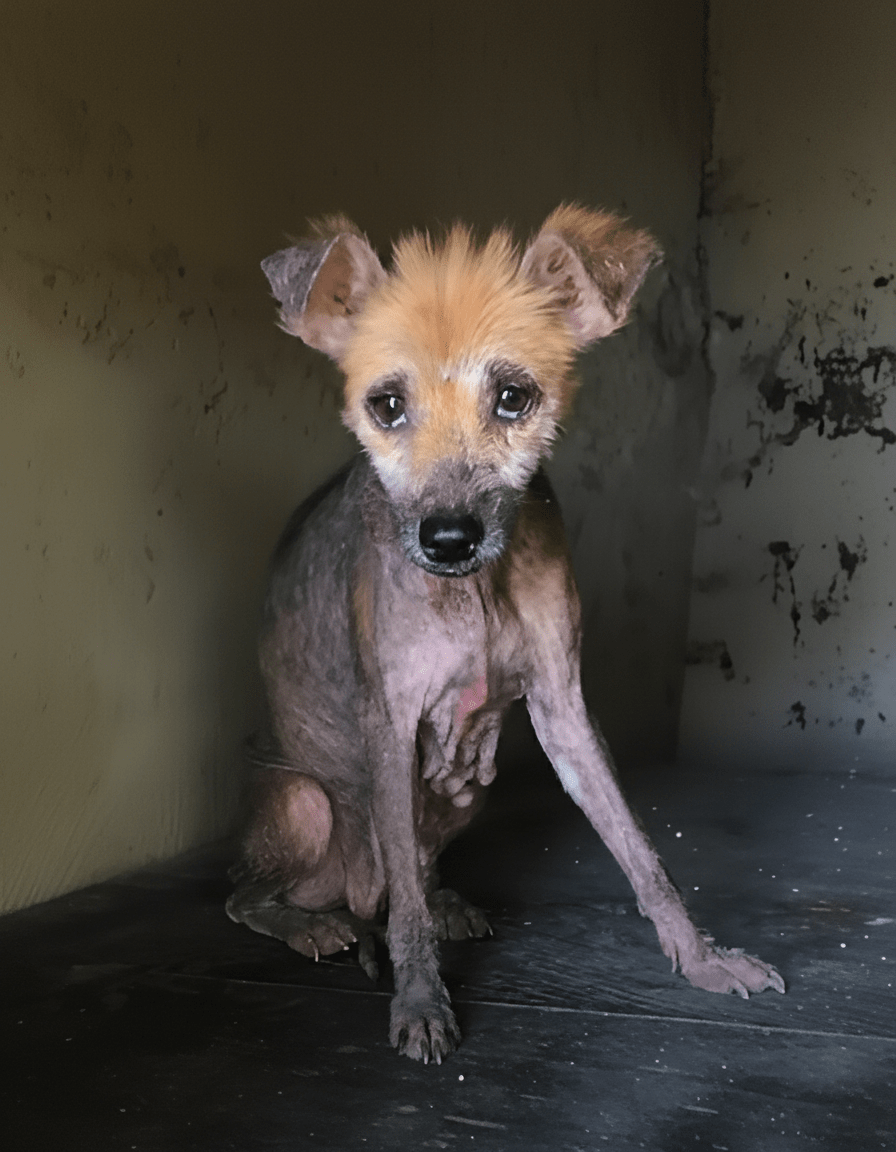
In the sweltering heat of Bali’s chaotic backstreets, where the air hangs heavy with the scent of sizzling satay and exhaust fumes from endless scooter traffic, a tiny, hairless dog huddled in the shadows of a crumbling concrete kennel. Her name, unknown to the world at the time, would later become Lucy Ray—a moniker evoking both fragility and radiant hope. It was July 2023, during the peak of Indonesia’s dry season, when a routine patrol by a local animal welfare volunteer uncovered this heartbreaking sight. The dog, no larger than a house cat, sat motionless amid piles of discarded plastic bottles and rainwater puddles, her skin marred by open sores, her eyes clouded with infection, and her frail body trembling from malnutrition. What no one could have predicted was that this forsaken creature, rescued from the fringes of paradise, would embark on a globe-trotting journey of redemption, touching lives across continents and defying every expectation of survival.

The discovery happened by sheer accident. Australian expat and veterinary technician Sarah Wilkins, who had relocated to Bali five years earlier to run a small animal clinic in Ubud, was returning from a supply run in Denpasar when her motorbike sputtered to a halt near a bustling wet market. As she waited for roadside assistance under a banyan tree, she heard faint whimpers emanating from a makeshift enclosure fashioned from corrugated tin and wooden pallets—likely an impromptu holding pen for strays before they faced uncertain fates at the hands of local butchers or indifferent authorities. Peering inside, Sarah’s heart sank. The dog, later identified as a mix of Chinese Crested and local Indonesian street breeds, had almost no fur left; what remained on her head was a patchy, rust-colored tuft matted with dirt and parasites. Her legs, skeletal and elongated, ended in paws cracked and bleeding from constant scavenging on scorching asphalt.
Sarah’s initial assessment was grim. “She was covered in demodectic mange, a parasitic infestation that had eaten away at her skin,” Sarah recounted in an interview with Bali Animal Rescue Network (BARN). Blood tests later revealed severe anemia, a liver compromised by toxin exposure—possibly from ingesting garbage laced with rat poison—and early signs of heartworm disease rampant in tropical climates. Weighing just 2.8 kilograms (about 6 pounds), Lucy Ray was on the brink of organ failure. Yet, in a twist that would define her story, the little dog lifted her head and licked Sarah’s hand through the bars, a gesture of trust amid unimaginable suffering. That single act compelled Sarah to act immediately. She contacted BARN, who dispatched a team within hours, navigating monsoon-flooded alleys to extract her.
Rescue, however, was only the beginning of an odyssey filled with unexpected hurdles. Bali’s animal welfare infrastructure is notoriously strained; with over 500,000 stray dogs on the island alone, resources are scarce. Lucy Ray’s treatment began in a crowded shelter in Gianyar, where she shared space with boisterous puppies and recovering fighting dogs. Vets administered ivermectin for mange, antibiotics for secondary infections, and a high-calorie recovery diet of boiled chicken and rice. But complications arose swiftly. On day five, she developed a severe allergic reaction to a standard flea treatment, causing her skin to swell and her breathing to labor—a rare anaphylactic response that required an emergency transfer to a human hospital’s ICU for oxygen support. “We thought we’d lose her that night,” admitted Dr. Wayan Putra, the lead veterinarian. Miraculously, she stabilized after 48 hours of round-the-clock monitoring.

As Lucy Ray gained strength—her weight climbing to 4 kilograms in two weeks—another surprise emerged: her pedigree. Genetic testing, donated by an international lab, revealed she carried genes from rare hairless breeds, suggesting an abandoned pet rather than a pure street dog. This revelation caught the attention of global animal lovers when Sarah posted her progress on Instagram. One video, showing Lucy Ray’s first wobbly steps post-treatment, garnered 2.3 million views and messages from as far as Sweden and Canada. Among them was an email from Emily Hargrove, a 34-year-old graphic designer in Richmond, Virginia, USA. Emily, who had lost her senior Chihuahua to cancer the previous year, felt an inexplicable pull. “Her eyes in that photo—they weren’t defeated; they were hopeful,” Emily said. What started as a donation turned into a sponsorship, and within months, a bold plan formed: adoption across the Pacific.
The logistics of transporting a fragile, recovering dog from Bali to the United States proved a saga of bureaucratic nightmares and serendipitous aids. International pet relocation requires rabies vaccinations, microchipping, and USDA-approved health certificates—processes complicated by Indonesia’s variable enforcement. Lucy Ray’s flight was delayed twice: first by a volcanic eruption from Mount Agung that grounded planes for days, blanketing Bali in ash, and second by a paperwork error that misidentified her as a “high-risk breed.” Enter unexpected hero number two: Captain Michael Torres, a pilot for a cargo airline who volunteered his off-duty time to escort her personally. A dog lover with his own rescue Chinese Crested at home, Michael rerouted through Singapore, hand-carrying Lucy Ray through customs in a custom airline-approved crate lined with cooling gels to combat the 35°C (95°F) heat.
She arrived at Richmond International Airport on November 12, 2023, after a 28-hour journey, greeted by Emily and a small crowd of supporters from local rescue groups. But adaptation wasn’t seamless. Virginia’s crisp autumn air triggered a flare-up of her skin condition, and the transition from tropical humidity to central heating caused dry, itchy patches. Emily consulted specialists at Virginia Tech’s Marion duPont Scott Equine Medical Center (which also treats exotic pets), where Lucy Ray underwent laser therapy and a custom regimen of oatmeal baths and medicated shampoos. In a delightful twist, her fur began to grow back—not the sparse tufts expected, but a soft, golden coat that made her look like a plush toy. “She transformed before our eyes,” Emily laughed.
Today, Lucy Ray’s life in Virginia is a far cry from her Bali origins. She shares a cozy two-bedroom home with Emily, her husband Tom (a software engineer), and their two cats, Luna and Max. Her daily routine includes morning walks along the James River, where she chases squirrels with surprising vigor, and afternoons lounging on a heated pet bed while Emily works from home. Unexpectedly, Lucy Ray has become a therapy dog; after passing certification with the Alliance of Therapy Dogs in just four months, she visits nursing homes in Richmond, bringing comfort to elderly residents. “She senses sadness,” Emily notes. “She’ll nuzzle someone who’s quiet and stay with them until they smile.”
Her story has rippled outward, inspiring tangible change. Donations from her viral fame helped BARN build a new quarantine facility in Bali, reducing euthanasia rates by 30% in 2024. Emily launched the Lucy Ray Foundation, partnering with rescues in Thailand and the Philippines to fund mange treatments for 500 street dogs last year. And in a poetic full-circle moment, Sarah Wilkins visited Virginia this summer, reuniting with her first “miracle pup” during a backyard barbecue where Lucy Ray playfully tugged at her shoelaces.
Lucy Ray’s journey—from a forgotten stray in Bali’s unforgiving streets to a beloved family member and advocate in America’s heartland—stands as a testament to resilience and human compassion. At three years old, with a glossy coat, bright eyes, and a spirited bark, she embodies the profound truth that love can heal even the deepest wounds. Her tale reminds us that behind every rescued animal is a story of unexpected heroes, improbable odds, and the unbreakable spirit that turns despair into joy. As Emily often says, “Lucy Ray didn’t just survive; she bloomed.” And in doing so, she has changed countless lives forever.
