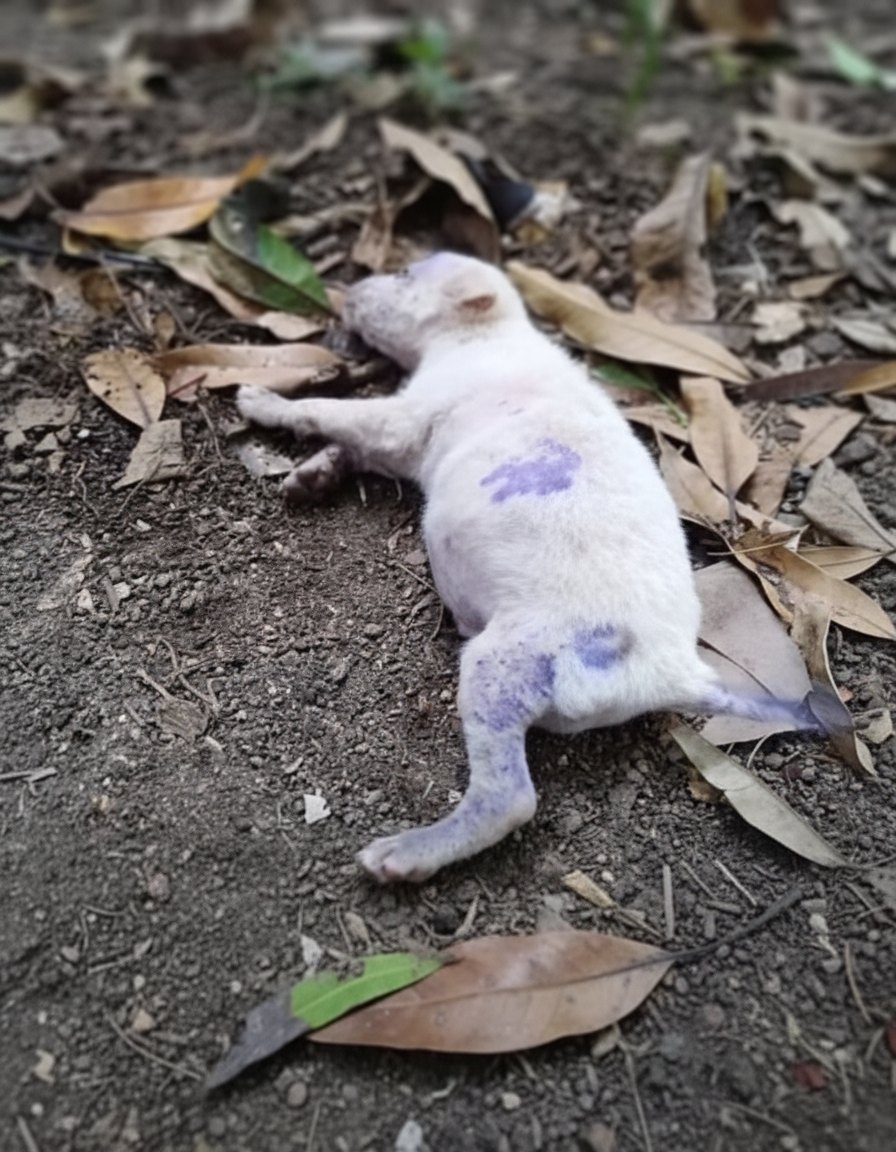
In the sweltering heat of a late September afternoon in 2024, beneath the sprawling teak trees and scattered monsoon-kissed leaves of a quiet hamlet in Odisha, India, a group of children playing near the edge of the jungle stumbled upon a sight that would haunt them for years. The air was thick with the scent of damp earth and decaying foliage, and the distant hum of cicadas provided an eerie backdrop as 10-year-old Ravi Das and his younger sister Priya pushed through the underbrush, chasing a brightly colored butterfly. What they found lying motionless amid the leaf litter was not a fallen bird or a discarded toy, but a tiny puppy—no more than six weeks old—its fragile white fur marred by vivid, unnatural splotches of purple dye that streaked across its back, hindquarters, and one floppy ear. The puppy’s eyes were half-open, glassy and unseeing, its tiny chest still, and a faint, acrid chemical smell lingered around its body. Ravi froze, his hand clutching Priya’s, as the reality sank in: this was no ordinary stray. The bizarre coloration and the puppy’s emaciated frame suggested a story far more sinister than abandonment, one that would soon unravel into a web of rural superstition, illegal commerce, and heartbreaking cruelty, captivating national media and igniting debates across India about animal welfare in forgotten corners of the country.

The discovery quickly escalated from a child’s fearful whisper to a village-wide alarm. Ravi ran home, tears streaming down his face, and alerted his mother, Sunita Das, a local seamstress who immediately called the village sarpanch (head). By evening, a small crowd had gathered at the site, their murmurs mixing with the rustling leaves. The purple hue wasn’t fading; if anything, it seemed to glow faintly under the setting sun, drawing gasps from onlookers. One elder, trembling with anger, pointed out the puppy’s paws—stained not just purple but also with traces of a sticky, golden residue that smelled faintly of honey. “This is no accident,” he declared. “Someone marked it for a reason.” Photographs taken on mobile phones spread like wildfire through WhatsApp groups, reaching the nearest town of Jeypore by nightfall. Local animal lover and retired veterinarian Dr. Anil Mishra, who had moved to the area five years earlier to care for strays, arrived the next morning with gloves and sample kits. His initial examination revealed unexpected details: the dye was not simple food coloring but a commercial-grade gentian violet antiseptic mixed with an unidentified adhesive, commonly used in veterinary clinics but toxic in high concentrations to such a young animal. Embedded in the puppy’s matted fur were tiny fibers from jute rope, and around its neck was a faint, chafed ring suggesting it had been bound recently.
As news crews from Bhubaneswar descended on the village two days later, the investigation took an astonishing turn. Police Superintendent Rakesh Kumar revealed that the puppy—later named “Lavender” by activists—had not died from starvation or exposure, as first assumed. A post-mortem conducted at the Jeypore Veterinary Hospital uncovered micro-fractures in its ribs and a perforated intestine, consistent with blunt force trauma. But the most shocking finding was in its stomach: alongside traces of the purple dye, veterinarians discovered fragments of cheap plastic beads and a single, unbroken clove of garlic. “This combination points to a ritual,” Dr. Mishra explained in a press conference, his voice steady but eyes filled with sorrow. “In some rural communities, puppies are dyed and prepared as offerings to ward off evil spirits during the post-monsoon season.” What made this case stand out was the unexpected sophistication of the markings: the purple splotches formed deliberate patterns—irregular stars and crescents—that matched symbols from Tantric traditions rarely practiced openly in Odisha. Further analysis by a forensic lab in Cuttack confirmed the dye contained traces of arsenic, a slow-acting poison that would have caused agonizing internal bleeding over 24-48 hours.
The trail led investigators to an unlikely suspect: 52-year-old Mohan Pradhan, a reclusive palm reader who lived on the outskirts of the village in a thatched hut adorned with colorful charms. Neighbors described him as harmless, a man who traded herbal remedies for small fees and occasionally performed pujas for worried farmers. But a search of his home yielded damning evidence. Hidden beneath floorboards were jars of gentian violet, coils of jute rope, and a ledger detailing “protective services” for 17 clients over the past year—each entry noting the type of animal used and the fee charged, ranging from 500 to 2,000 rupees ($6 to $24 USD). Tucked among the jars was a Polaroid photograph of Lavender, taken alive, showing the puppy tied to a wooden post with purple dye freshly applied. Even more startling, the photo’s timestamp revealed it had been taken just 72 hours before the children found the body—meaning the puppy had suffered in the jungle, unable to nurse or move freely, while its killer collected payment from a local shopkeeper fearing crop failure.

Pradhan’s confession, recorded on October 5, 2024, added layers of unexpected tragedy. He claimed the practice was inherited from his grandmother, who believed white puppies with purple markings could absorb “malevolent energies” during Pitru Paksha, a Hindu ancestral observance. But the true horror emerged when he admitted to sourcing the puppies from a clandestine network operating across state lines. “They come from Bihar and Uttar Pradesh,” he said, naming a middleman in Jharkhand who supplied “purebred whites” for 200 rupees each. Police raids in the following weeks uncovered a puppy trafficking ring spanning three states, with over 40 animals rescued from cramped crates in a warehouse near Ranchi. Among them were four more puppies with partial purple markings, including one with a eerily similar star-shaped blotch on its flank. The ring’s leader, a 38-year-old former chemist named Vikram Singh, had adapted industrial dyes to make the animals “more potent” for rituals, blending them with honey to mimic sacred offerings—a detail that explained the sticky residue on Lavender’s body.
The Lavender case exploded into a national scandal, with hashtags like #JusticeForLavender and #EndRitualCruelty trending on social media for weeks. Animal rights organizations such as People for Animals and Blue Cross of India mobilized, collecting over 150,000 signatures for a petition urging stricter enforcement of India’s Prevention of Cruelty to Animals Act, 1960. In a surprising alliance, Bollywood actress and activist Dia Mirza visited the village, adopting two rescued siblings of Lavender and pledging funds for a local shelter. Public outrage led to Pradhan’s arrest on charges of animal cruelty and illegal trade, while Singh faced additional counts of poisoning and trafficking. Yet, the story’s most poignant twist came from an unexpected source: one of Pradhan’s clients, a widowed farmer named Laxmi Devi, came forward with remorse. “I paid for protection, not death,” she wept on camera. “No one told me the puppy would suffer.” Her testimony humanized the demand side of the tragedy, revealing how poverty and superstition intertwined to perpetuate the cycle.
As of November 2024, the case continues to reverberate. Odisha’s government announced a statewide awareness campaign, deploying mobile veterinary units to remote villages and training local leaders on humane alternatives to rituals. Dr. Mishra, now a reluctant hero, founded the Lavender Foundation, which has spayed and vaccinated over 200 strays in Jeypore alone. Ravi and Priya, the children who found the puppy, have become junior ambassadors for the cause, speaking at schools about compassion. The purple puppy’s story, born from a moment of innocent play amid fallen leaves, exposed a hidden underbelly of cruelty in modern India—one where ancient beliefs clash with legal protections, and tiny lives hang in the balance.
But Lavender’s legacy extends beyond borders. Similar incidents have surfaced in neighboring countries: in rural Bangladesh, a blue-dyed kitten was found in October 2024, linked to flood-averting ceremonies; in Nepal’s Terai region, green-marked goats appeared in shamanic healings. These cases underscore a grim pattern: in developing regions, economic desperation fuels markets for “sacrificial” animals, often adorned with dyes to signify purity or power. Experts estimate thousands of pets suffer annually, their deaths rationalized as necessary for communal well-being.
The image of that purple puppy, shared millions of times online, serves as a stark reminder: behind every act of cruelty lies a story demanding attention. In Odisha’s jungles, Lavender’s short life has sparked change, proving that one small, stained body can ignite a movement for mercy. As the leaves continue to fall, the village of Jeypore watches, hoping no more colors of suffering will stain its earth.
