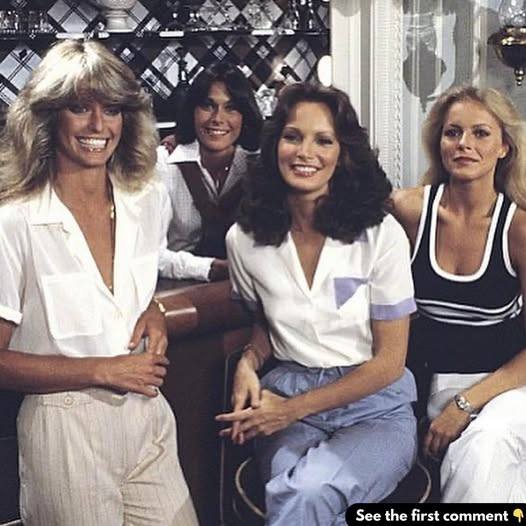
When Charlie’s Angels premiered in 1976 — not 1967, as some sources mistakenly claim — television shifted in a way few could have predicted. For the first time, audiences saw women not as assistants or love interests, but as the leads: capable, confident, stylish, and unafraid to take control.
Created by Ivan Goff and Ben Roberts, the series introduced viewers to Farrah Fawcett as Jill Munroe, Kate Jackson as Sabrina Duncan, and Jaclyn Smith as Kelly Garrett — three private investigators working for the unseen Charlie Townsend. These “Angels” cracked cases, outsmarted villains, and challenged outdated expectations, forever changing how female heroes were portrayed on TV.
A New Era in Television
When the show debuted, male-led detective dramas dominated the airwaves. Women were typically cast in supportive or decorative roles. But Charlie’s Angels flipped the script overnight.
These women weren’t side characters — they were the story. Smart, skilled, and fearless, they carried each episode with a mix of humor, mystery, action, and undeniable charisma. The show’s fashion-forward look and youthful energy resonated strongly with viewers of the late ’70s.
Beyond being glamorous detectives, the Angels became cultural symbols. They wore the latest trends, faced danger head-on, and showed that femininity and strength were not opposites. For countless young women, they became early icons of independence and aspiration.
The Women Who Defined the Phenomenon
The original cast became instant stars. Farrah Fawcett’s radiant presence and iconic feathered hair made her a global sensation — her famous red swimsuit poster became one of history’s best-selling images. Jaclyn Smith brought elegance and warmth, while Kate Jackson delivered intelligence and steady leadership.
As the series evolved, cast changes reshaped the team but never dimmed the show’s appeal. Cheryl Ladd stepped in as Kris Munroe after Fawcett’s departure, followed by Shelley Hack and later Tanya Roberts. Through all these transitions, Jaclyn Smith remained the show’s lasting anchor.
Despite rotating cast members, the core message stayed the same: women lifting each other up, breaking boundaries, and taking the lead with courage and heart.
Beyond Glamour: A Deeper Impact
Though critics sometimes dismissed the show as “jiggle TV,” its cultural impact was far more meaningful. The Angels were among the first women on television portrayed as fully independent professionals — not defined by marriage, motherhood, or their relationships to men.
At a time when the women’s movement was reshaping society, Charlie’s Angels helped bring conversations about female empowerment into mainstream entertainment. Viewers saw women who were both fashionable and formidable, proving they didn’t need to sacrifice style to be taken seriously.
Cultural Influence and Enduring Popularity
By its second season, the show ranked among television’s top-rated programs. Hairstyles, outfits, and even attitudes from the show shaped fashion and culture across the country. Young fans wanted to look, act, and walk with the Angels’ confidence.
But by the early 1980s, the series began to lose momentum. Critics pointed to repetitive plots, and viewership declined. The finale in 1981 closed the chapter — but not its legacy.
Charlie’s Angels opened doors for future female-driven shows like Alias, Buffy the Vampire Slayer, Killing Eve, and Scandal. It proved an undeniable truth: audiences would wholeheartedly embrace women as action heroes and central figures.
Hollywood Brings the Angels Back
The brand proved too iconic to remain dormant. In 2000, the franchise exploded back into popularity with a high-energy film starring Cameron Diaz, Drew Barrymore, and Lucy Liu. Packed with humor, explosive action, and modern sisterhood, the movie became a worldwide hit, followed by a sequel in 2003.
A brief ABC reboot in 2011 attempted to recapture the magic but lasted only seven episodes. A newer 2019 film starring Kristen Stewart, Naomi Scott, and Ella Balinska modernized the concept with global missions and diverse agents, though it struggled commercially.
Despite mixed success, each revival demonstrated just how deeply Charlie’s Angels is woven into pop culture.
A Legacy That Continues to Inspire
Decades after its premiere, Charlie’s Angels remains one of television’s most recognizable brands. But its true influence goes beyond ratings or reboots — it altered expectations for how women could be represented on screen.
Before the Angels, female characters were often secondary. After them, they became leaders. Before the Angels, women rarely anchored action franchises. After them, they drove some of Hollywood’s biggest hits.
The Angels’ blend of grace, intelligence, humor, and courage helped dismantle stereotypes and paved the way for richer, more nuanced portrayals of women across all genres.
Conclusion: A Cultural Breakthrough That Still Matters
Charlie’s Angels was far more than a show about three detectives. It was a milestone in television history, arriving at a time when society was ready for — and in need of — new ideas about womanhood and power.
Through charm, bravery, and unwavering camaraderie, the Angels kicked down doors both on screen and in real life. Today, as new generations discover the series, its message still resonates: empowerment comes in many forms, and heroism isn’t defined by gender.
In the end, Charlie’s Angels wasn’t just a series — it was a statement. A revolution wrapped in glamour. And its legacy continues to shine, reminding us that when women step into the spotlight, they can change everything.